
Imagine being handed 4 million documents, emails, contracts, PDFs, chat logs, spreadsheets and told you have three weeks to find the ten pieces of evidence that will decide a multi-billion dollar lawsuit. No index. No guide. Just data.
This is not a hypothetical. This is the daily reality of AI eDiscovery in modern litigation, regulatory investigations, and corporate compliance audits. And for most of legal history, the only way to tackle it was to throw armies of human reviewers at the problem a slow, expensive, and painfully error-prone process.
Artificial intelligence has redefined what’s possible. Today, AI-powered eDiscovery tools can sift through millions of documents with unmatched speed and accuracy pinpointing critical insights long before opposing counsel gets there.
What Is eDiscovery — and Why Does It Matter?
eDiscovery, or electronic discovery, is the process by which legally relevant electronically stored information (ESI) is identified, collected, preserved, reviewed, and produced during litigation, regulatory investigations, and internal compliance reviews.
ESI includes virtually every form of digital communication and documentation your organization produces: emails, contract documents, PDFs, Word files, spreadsheets, instant messages, social media posts, voicemails, and increasingly, data from collaboration platforms like Slack and Microsoft Teams.
The scale of the challenge is staggering and growing fast.
$20.74 billion projected global eDiscovery market size in 2026, growing toward $46 billion by 2034 (Fortune Business Insights)
Over 90% of all records today are created electronically, making eDiscovery unavoidable in any modern legal matter
75% — of total discovery costs typically consumed by document review alone
Fortune 1000 companies spend between $5 million and $10 million annually on eDiscovery activities. For large litigation matters, costs can run even higher. The pressure to reduce that spend while increasing accuracy and speed has made AI eDiscovery one of the most actively developed areas in legal technology.
The Needle in the Haystack Problem
Legal teams have always faced a version of the needle-in-a-haystack challenge. Even before digital records, attorneys sifted through boxes of paper documents searching for the one memo, the one email chain, the one contract clause that would change everything about a case.
The digital era made the haystack exponentially larger. A single mid-sized litigation matter today can involve hundreds of gigabytes, sometimes terabytes of ESI. Global data volumes are projected to exceed 221,000 exabytes by 2026. Each new communication platform, each cloud storage system, each business application adds another layer of potential evidence that legal teams must account for.
Traditional linear review where human reviewers manually read through documents one at a time was never designed to handle this volume. It is slow, expensive, inconsistent, and increasingly unsustainable as data volumes grow.
The consequences of getting it wrong are serious. Missing a critical document in production can expose a client to adverse inference rulings, sanctions, or outright case-deciding disadvantages. Producing too many documents increases cost, creates confidentiality risks, and buries opposing counsel in data sometimes itself a costly strategy to execute.
How AI eDiscovery Changes the Game
AI eDiscovery tools use machine learning, natural language processing (NLP), and predictive analytics to automate and dramatically accelerate every phase of the discovery process from initial data collection and processing through review, privilege screening, and production.
Here is how AI approaches each stage of the discovery challenge:
Early case assessment (ECA)
Before committing to a full review, legal teams need to understand what they are dealing with. AI-powered ECA tools can rapidly analyze an entire document corpus identifying key custodians, relevant time periods, significant topics, and likely data sources in a fraction of the time a manual assessment would require. Everlaw, a leading eDiscovery platform, reports that users slash documents promoted to active review by 74% using AI-powered early case assessment.
Technology-assisted review (TAR) and predictive coding
TAR, also known as predictive coding, is where AI has arguably made its most significant impact on eDiscovery. The system learns from a small set of documents reviewed and coded by a senior attorney, then applies that learning across the entire document set predicting which documents are relevant, privileged, or responsive to specific requests. This approach reduces review volume by 50 to 70% compared to linear review while matching or exceeding the accuracy of human review on relevant document identification.
Keyword and conceptual search
AI-powered search goes far beyond simple keyword matching. Modern eDiscovery platforms use semantic search and NLP to understand the meaning and context behind queries finding documents that contain the concept being searched even when they do not use the exact keywords specified. This addresses one of the core weaknesses of traditional keyword-only search, which consistently produces both over-inclusive and under-inclusive results depending on the terms selected.
Privilege review and sensitive information detection
Identifying privileged communications and sensitive information within a large document set is one of the highest-risk and most time-consuming aspects of document review. AI tools trained on legal privilege patterns can rapidly flag communications involving counsel, privileged subject matter, and potentially sensitive terms enabling reviewers to focus their attention where it matters most rather than reading every document from scratch.
Automated summarization and reporting
Once relevant documents are identified, AI can generate structured summaries, extract key facts, and compile timeline data tasks that previously required significant manual effort. Legal teams can move from identified documents to actionable insights in hours rather than days.
The Numbers That Are Driving AI eDiscovery Adoption
The shift toward AI in eDiscovery is not merely theoretical. Adoption data from across the legal industry confirms that AI tools are rapidly becoming the operational standard rather than an experimental option.
95% — of eDiscovery professionals express medium to high trust in AI for eDiscovery tasks (Lighthouse Global 2025 AI in eDiscovery Report)
69% — of legal professionals are already using general-purpose AI tools for work, with eDiscovery among the primary use cases (8am 2026 Legal Industry Report)
26% — of legal professionals report already using generative AI nearly double the 14% reported in 2024 (Thomson Reuters Institute)
16.1% CAGR AI-in-eDiscovery segment growth rate through 2030, reaching $733 million (Grand View Research)
The adoption curve is steep and accelerating. Legal teams that delay investing in AI eDiscovery capability are not standing still they are falling behind opponents who are already using these tools to prepare cases faster, identify evidence more completely, and control costs more effectively.
AI eDiscovery for Different Legal Contexts
AI-powered eDiscovery delivers value across a wide range of legal and compliance scenarios:
Commercial litigation
Contract disputes, breach of fiduciary duty claims, and complex commercial litigation routinely involve large ESI sets spanning multiple years and custodians. AI eDiscovery dramatically compresses the timeline from data collection to trial-ready document production.
Regulatory investigations
SEC inquiries, DOJ investigations, GDPR compliance audits, and other regulatory matters require rapid, defensible document production under strict timelines. AI tools provide the speed and auditability that these high-stakes situations demand.
Internal investigations
When organizations investigate potential misconduct, AI eDiscovery enables investigators to quickly surface relevant communications and documents while maintaining confidentiality and chain of custody critical factors in both internal and potentially subsequent external proceedings.
Intellectual property disputes
Patent litigation, trade secret cases, and copyright disputes often involve highly technical documentation. AI systems trained on technical vocabulary can identify relevant prior art, patent claims, and technical communications with a precision that generic keyword searches cannot match.
Merger and acquisition due diligence
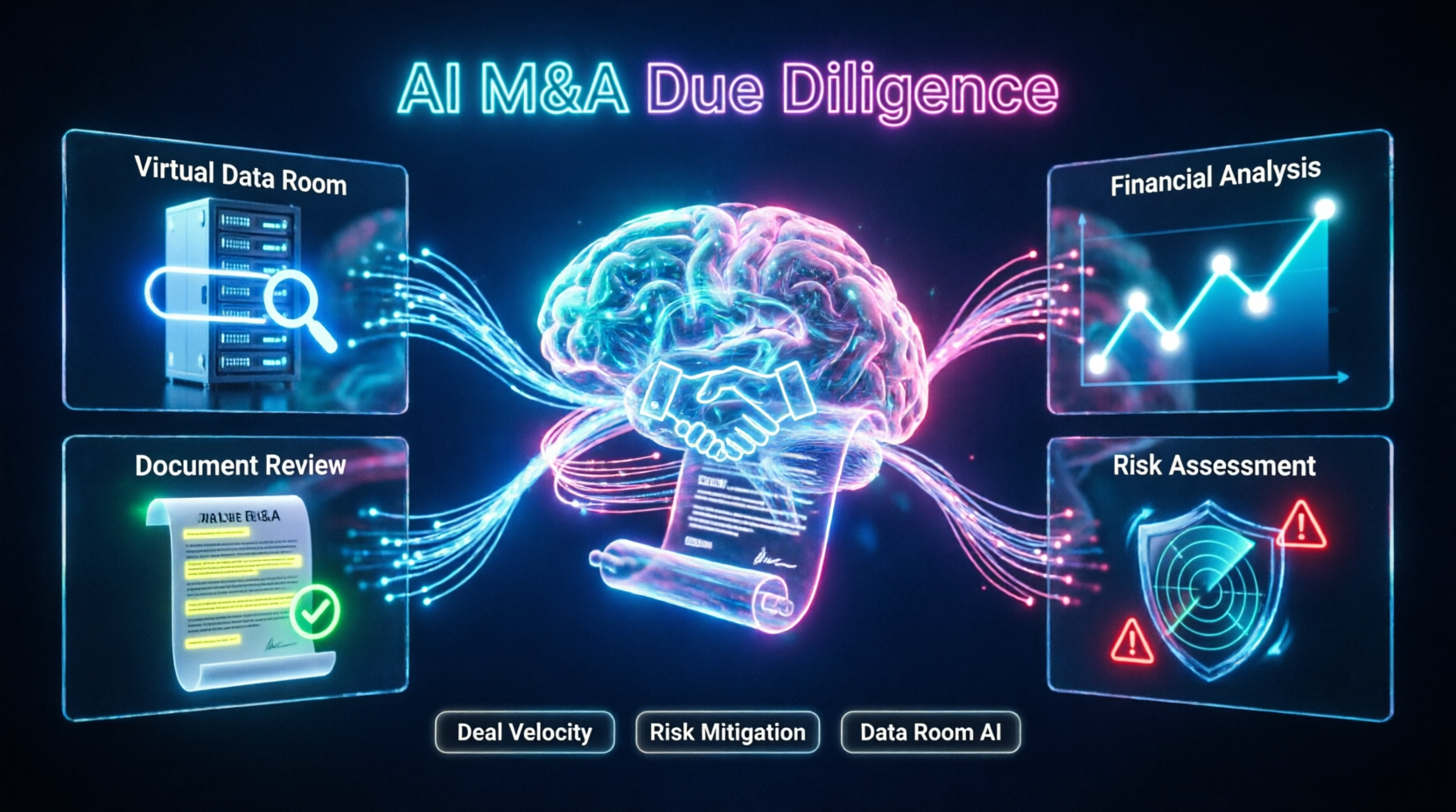
M&A transactions require rapid review of large volumes of contracts, regulatory filings, and operational documents under tight deal timelines. AI document analysis tools accelerate this process significantly often turning what was a weeks-long exercise into a days-long one.
What Makes a Good AI eDiscovery Solution?
Not all AI eDiscovery tools deliver equal value. When evaluating a platform, legal teams should assess it against these key criteria:
• Accuracy and defensibility can the platform produce an auditable, court-defensible record of its review methodology? This is non-negotiable in litigation contexts.
• Processing speed: how quickly can it ingest, process, and make searchable a large corpus of mixed-format documents?
• Format support does it handle the full range of modern ESI formats, including PDFs, Word documents, emails, spreadsheets, and collaboration platform exports?
• Semantic and conceptual search does it go beyond keyword matching to surface conceptually relevant documents?
• Privilege and risk detection does it reliably flag potentially privileged or sensitive content for attorney review?
• Summarization and reporting does it support efficient attorney review by generating document summaries and structured reports?
• Data security: what encryption, access controls, and data residency options are available? In legal matters, document security is paramount.
• Integration does it connect with existing document management, case management, and cloud storage systems?
ZDS: AI Document Analysis Built for Legal and Compliance Work
Zeal Driven Solutions (ZDS) is an AI-powered document analysis platform designed specifically to address the document review and intelligence challenges that legal professionals, compliance teams, and researchers face every day.
While traditional eDiscovery platforms focus primarily on collection and processing, ZDS is built around the intelligence layer helping legal teams and their clients extract meaning, identify key terms, flag risks, and answer specific questions from documents at scale.
With ZDS, legal professionals can upload agreements, contracts, and complex legal documents individually or in batches from Google Drive and immediately begin extracting the information that matters. The platform’s query-based interaction model allows attorneys to ask specific questions directly: ‘Does this agreement contain an indemnification clause?’ or ‘What are the governing law provisions in this contract?’ and receive targeted, document-sourced answers in seconds.
ZDS also generates structured reports that summarize key findings, highlight risk terms, and provide clear, shareable overviews for clients and stakeholders who need the intelligence without wading through the full document. And like all serious legal technology, ZDS is built with robust data security and encryption at its core because in legal matters, confidentiality is never optional.
For law firms, in-house legal teams, compliance functions, and consulting organizations dealing with high volumes of complex documents, ZDS delivers the AI-powered document intelligence that turns the needle-in-a-haystack problem into a solved problem.
Conclusion: The Future of eDiscovery Is Already Here
The eDiscovery challenge has always been fundamentally about finding what matters in an overwhelming sea of information. AI has changed the answer to that challenge from ‘hire more reviewers and hope’ to ‘deploy intelligent tools that learn, adapt, and deliver results at machine speed.’
With the global eDiscovery market projected to grow from $20 billion in 2026 toward $46 billion by 2034, and AI adoption among legal professionals accelerating rapidly, the question for any organization involved in litigation, investigations, or compliance work is no longer whether to use AI eDiscovery it is which platform to trust with the work.
The needle is still in the haystack. AI just finds it in minutes instead of months.
Discover how Zeal Driven Solutions can transform your document review and legal analysis workflow. Visit zealdrivensolutions.ai to explore the platform or book a free demo with the ZDS team.