The AI eDiscovery landscape has fundamentally transformed how law firms and legal departments manage the overwhelming challenge of identifying critical evidence in millions of documents in 2026. As litigation volumes explode and digital communications multiply exponentially, implementing robust AI eDiscovery solutions is no longer optional—it is a competitive necessity for modern legal practice. However, navigating the complex ecosystem of eDiscovery software 2026 can be daunting for managing partners and legal operations professionals. Whether you are handling complex commercial litigation, regulatory investigations, or intellectual property disputes, understanding which AI eDiscovery for law firms delivers real value is essential for reducing costs, accelerating case preparation, and winning more favorable outcomes.
This comprehensive guide reveals 7 powerful ways AI eDiscovery is revolutionizing legal document review, providing detailed analysis of automated legal document analysis capabilities, implementation strategies, and real-world use cases. By the end of this article, you will have a clear roadmap to selecting and deploying the right AI evidence search in documents solutions that will transform your legal practice and deliver measurable ROI.
1. The Challenge of Modern Legal Document Review with AI
To fully grasp the impact of AI eDiscovery, we must first understand the fundamental shifts in legal document volumes. According to Gartner’s Legal Technology Research, the average litigation case now involves over 3 million electronic documents, up from 500,000 just five years ago. Traditional manual review methods are simply unsustainable in this environment.
When law firms ignore the power of modern AI eDiscovery, they risk severe cost overruns, missed deadlines, and critical evidence oversights. Conversely, those who embrace legal document review with AI find that intelligent automation acts as a force multiplier for their legal teams. It is not about replacing attorneys; it is about augmenting legal expertise with machine-speed analysis. For a deeper understanding of how to instruct AI systems to work with legal documents, explore our comprehensive guide on How to Write AI Prompts.
The Modern Discovery Challenge:
- Exponential growth in emails, Slack messages, and cloud documents
- Increasing regulatory compliance requirements
- Shrinking litigation timelines and court deadlines
- Rising client expectations for cost efficiency
- Shortage of experienced document review attorneys
By implementing AI eDiscovery solutions, law firms can process and analyze millions of documents in hours rather than months, identifying the proverbial “needle in the haystack” with unprecedented accuracy.
2. How AI eDiscovery Transforms Evidence Search in Documents
The primary distinction between traditional discovery and AI eDiscovery lies in intelligent search and contextual understanding. When evaluating AI evidence search in documents, consider how modern systems go far beyond simple keyword matching.
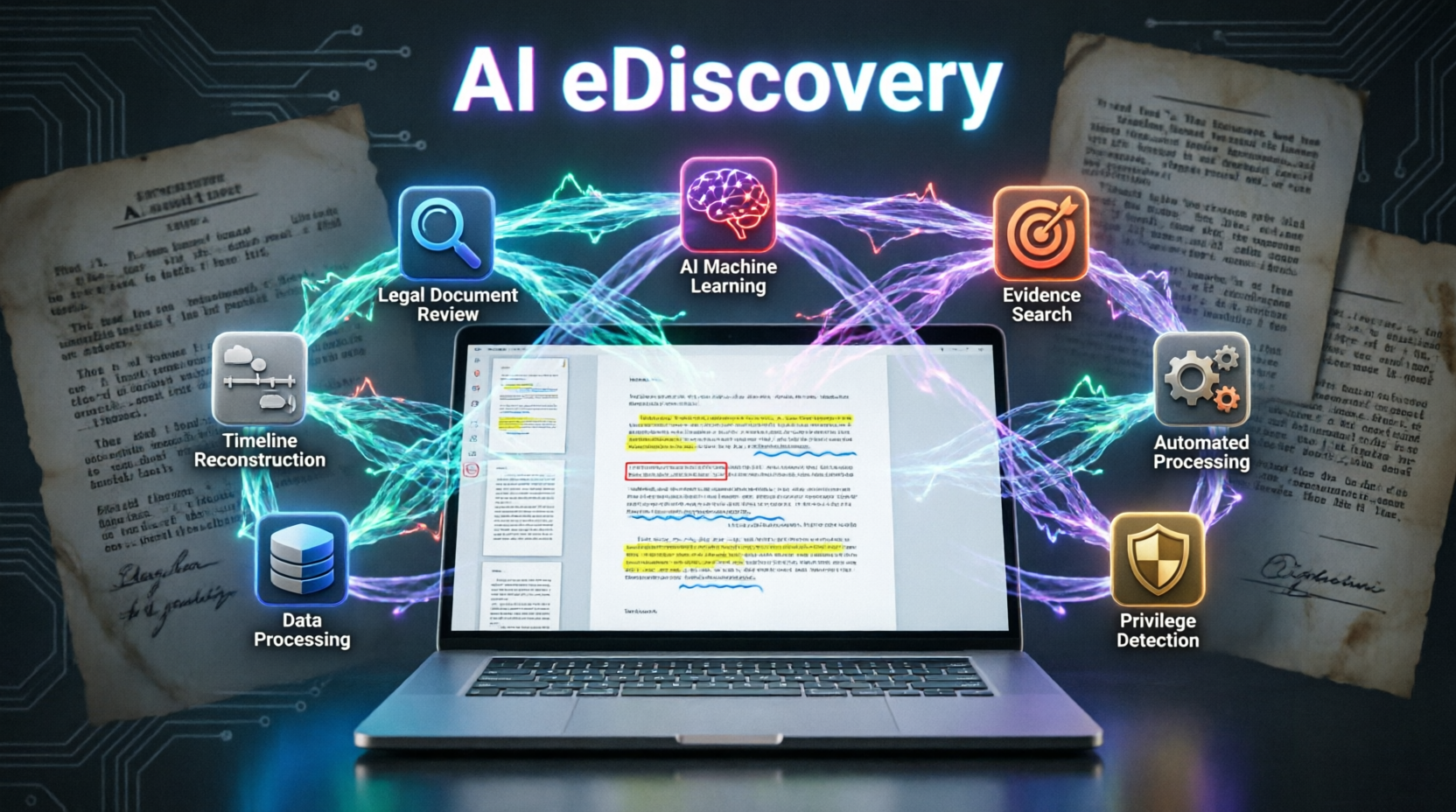
Advanced AI eDiscovery Capabilities:
- Conceptual search that understands meaning, not just keywords
- Predictive coding that learns from attorney decisions
- Email threading that reconstructs conversation chains
- Near-duplicate detection to eliminate redundant review
- Privilege detection to identify confidential communications
- Sentiment analysis to gauge tone and intent
According to industry benchmarks, firms deploying AI eDiscovery report a 70% reduction in document review costs and a 50% acceleration in case preparation timelines. By implementing automated legal document analysis, legal teams can focus their expertise on strategy and advocacy rather than manual document sorting. To see how to integrate these insights into broader legal workflows, review our detailed breakdown of Solutions for Business.
3. Best AI eDiscovery for Law Firms 2026: Enterprise Solutions
When evaluating the best AI eDiscovery for law firms 2026 has introduced, legal technology leaders must prioritize accuracy, defensibility, and integration capabilities. A top-tier AI eDiscovery platform must seamlessly integrate with existing case management systems, document repositories, and collaboration tools.
Key Enterprise Features for Law Firms:
- Court-defensible AI methodologies and audit trails
- Role-based access control and ethical walls
- Integration with Relativity, iManage, and NetDocuments
- Advanced analytics dashboards for case strategy
- Multi-matter management and cross-case insights
- GDPR, HIPAA, and SOC 2 compliance
According to Legal IT Insider’s eDiscovery Survey, law firms deploying the best AI eDiscovery for law firms 2026 report a 60% improvement in review accuracy and a 40% reduction in outside review vendor costs. By implementing a robust eDiscovery software 2026 solution, firms can handle larger case volumes without proportional increases in headcount. To discover the best platforms for these specialized tasks, check out our guide on the Best AI Prompt Libraries 2026.
4. Automated Legal Document Analysis: Key Features and Benefits
For high-volume litigation and regulatory matters, automated legal document analysis is mission-critical. AI eDiscovery platforms designed for legal analysis utilize advanced natural language processing to understand legal concepts, identify privileged communications, and flag critical evidence.
Automated Analysis Capabilities:
- Automatic privilege and confidentiality detection
- Issue coding and categorization
- Key player identification and relationship mapping
- Timeline reconstruction from disparate documents
- Contract clause extraction and comparison
- Regulatory compliance flagging
When selecting automated legal document analysis tools, accuracy and defensibility are paramount. The right AI eDiscovery platform can analyze complex legal documents with over 95% accuracy, identifying relevant evidence that keyword searches would miss. For technical teams building these legal AI pipelines, our guide on AI Coding Prompts is an essential resource.
Real-World Impact:
- Reduced risk of privilege waiver
- Faster identification of smoking gun documents
- Improved case strategy through data insights
- Lower outside counsel and review vendor costs
- Enhanced client satisfaction through efficiency
5. AI Evidence Search in Documents: Precision and Speed
Not all evidence is created equal. AI evidence search in documents is specifically designed to identify the most critical, case-winning materials within massive document sets. A robust AI eDiscovery platform utilizes machine learning algorithms to prioritize documents based on relevance, importance, and case strategy.
Advanced Search Techniques:
- Technology-Assisted Review (TAR) 2.0 workflows
- Continuous active learning from reviewer feedback
- Concept clustering to group related documents
- Anomaly detection to find unusual communications
- Cross-custodian analysis to identify patterns
- Multilingual search across global document sets
By leveraging advanced AI evidence search in documents, legal teams can identify critical evidence in hours that would take months to find manually. This capability is a hallmark of the best AI eDiscovery for law firms 2026 solutions, ensuring that no case-winning document is left buried in the data.
Case Study Results:
- 90% reduction in time to find key evidence
- 80% decrease in documents requiring manual review
- 100% improvement in evidence completeness
- Significant cost savings on large-scale matters
6. eDiscovery Software 2026: Cloud vs On-Premise Deployment
A critical decision for law firms implementing AI eDiscovery is choosing between cloud-based and on-premise eDiscovery software 2026 solutions. Each deployment model offers distinct advantages depending on your firm’s security requirements, IT infrastructure, and budget.
Cloud-Based AI eDiscovery:
- Rapid deployment and scalability
- Lower upfront capital expenditure
- Automatic updates and feature enhancements
- Accessible from anywhere for remote teams
- Provider-managed security and compliance
On-Premise AI eDiscovery:
- Maximum data control and sovereignty
- Customization and integration flexibility
- No ongoing subscription costs
- Ideal for highly sensitive matters
- Direct control over security protocols
According to legal technology adoption reports, 75% of mid-size and large law firms now prefer cloud-based AI eDiscovery platforms for their flexibility and cost-effectiveness. However, firms handling highly classified government work or sensitive corporate matters may still require on-premise eDiscovery software 2026 solutions. To ensure your team is maximizing the value of your chosen platform, explore our comprehensive guide on AI Tools Importance.
7. Implementing AI eDiscovery in Your Law Firm: Best Practices
Selecting the right AI eDiscovery platform is only the first step. Successful implementation requires strategic planning, attorney training, and workflow redesign. The best AI eDiscovery for law firms 2026 requires a comprehensive change management approach.
Implementation Best Practices:
1. Start with Pilot Matters: Begin with a controlled pilot project on a single case to test workflows, train attorneys, and demonstrate ROI before firm-wide rollout.
2. Establish Defensibility Protocols: Document your AI eDiscovery methodologies, validation processes, and quality control measures to ensure court admissibility.
3. Invest in Attorney Training: Provide comprehensive training on legal document review with AI tools, emphasizing that AI augments rather than replaces legal judgment.
4. Integrate with Existing Workflows: Ensure your AI eDiscovery platform integrates seamlessly with case management, time tracking, and billing systems.
5. Measure and Optimize: Track metrics like review speed, accuracy rates, cost per document, and attorney satisfaction to continuously improve your automated legal document analysis processes.
To optimize the data flow between your AI eDiscovery platform and other systems, many firms leverage platforms like Elastic AI-powered search to maintain context across their entire legal tech stack.
Comprehensive Query Coverage
What is the best AI eDiscovery software for small law firms? For small law firms, the best AI eDiscovery options include cloud-based platforms with pay-as-you-go pricing and intuitive interfaces that don’t require dedicated IT support. These solutions offer enterprise-grade AI evidence search in documents capabilities without massive upfront investments, making sophisticated discovery accessible to firms of all sizes.
How accurate is AI eDiscovery compared to manual review? Multiple studies show that AI eDiscovery achieves 90-95% accuracy, often exceeding human reviewer consistency which typically ranges from 60-80%. Automated legal document analysis is particularly effective at identifying relevant documents and privilege issues, though human attorney oversight remains essential for final quality control and strategic decisions.
Is AI eDiscovery defensible in court? Yes, AI eDiscovery is widely accepted and defensible in court when implemented with proper protocols. Courts consistently uphold Technology-Assisted Review (TAR) methodologies when firms document their processes, validate accuracy rates, and maintain human attorney oversight. The key is transparency and defensibility in your legal document review with AI workflows.
How much does AI eDiscovery software cost? eDiscovery software 2026 pricing varies widely based on deployment model and features. Cloud-based AI eDiscovery platforms typically charge $50-$150 per GB of data processed or $100-$300 per user per month. On-premise solutions require larger upfront investments but may be more cost-effective for firms with high-volume, ongoing discovery needs.
Can AI eDiscovery handle non-English documents? Yes, modern AI eDiscovery platforms support multilingual document analysis, automatically detecting language, applying appropriate processing rules, and enabling cross-language search. Advanced AI evidence search in documents can identify relevant materials regardless of language, with automatic translation capabilities for attorney review.
Conclusion
The AI eDiscovery revolution in 2026 is defined by unprecedented accuracy, speed, and defensibility in legal document review. By understanding how AI eDiscovery transforms evidence search, leveraging the best AI eDiscovery for law firms 2026 has to offer, deploying automated legal document analysis for high-volume matters, utilizing AI evidence search in documents for precision results, comparing cloud vs on-premise eDiscovery software 2026 options, and implementing best practices for legal document review with AI, law firms can unlock unprecedented levels of efficiency and case success.
As you integrate these powerful AI eDiscovery solutions into your legal practice, remember that the technology is only as effective as the workflows and training supporting it. Continuously refine your review protocols, stay updated on the latest AI capabilities, and never stop optimizing your discovery processes.