Mastering AI M&A due diligence is the absolute best way to ensure your organization navigates the complexities of mergers and acquisitions with unprecedented speed, accuracy, and risk mitigation. In an era where deal volumes are high and the window for execution is shrinking, relying on manual document review, fragmented spreadsheets, and exhaustive human proofreading is no longer a viable strategy for competitive corporate development. Today, forward-thinking investment banks, private equity firms, and corporate acquirers are leveraging advanced artificial intelligence to automate complex workflows, extract critical clauses, and identify hidden liabilities at scale. However, navigating the integration of these technologies requires strategic foresight. If you are looking to understand exactly how to evaluate these tools and select the right solutions to future-proof your deal pipeline, you are in the right place.
This comprehensive guide demystifies the technological horizon of modern deal-making. We will explore the most impactful applications of AI M&A due diligence, detail how M&A document review AI is revolutionizing deal velocity, and provide a strategic blueprint for deploying financial due diligence AI tools. By the end of this article, you will have a clear, actionable framework for evaluating deal document analysis software, understanding the total cost of ownership, and mastering the art of implementing due diligence checklist automation that delivers maximum ROI and risk mitigation.
1. The Evolution of Deal Making: Why AI M&A Due Diligence Matters in 2026
Historically, the due diligence phase of a merger or acquisition was defined by “data rooms” filled with thousands of pages of contracts, financial statements, and compliance records, reviewed by armies of junior analysts working grueling hours. As the legal and financial complexity of modern enterprises has grown exponentially, this traditional model has become economically unsustainable and prone to human error. The emergence of sophisticated Natural Language Processing (NLP) and Large Language Models (LLMs) trained specifically on legal and financial corpora has introduced a paradigm shift.
Understanding how to leverage AI in M&A due diligence is critical because the gap between AI-native deal teams and legacy practices is widening rapidly. Organizations that fail to modernize their diligence workflows risk severe inefficiencies, missed red flags, and loss of competitive advantage to more agile acquirers. The shift from basic keyword-search eDiscovery to cognitive, context-aware AI represents a monumental upgrade in capability. Modern systems do not just find words; they comprehend legal intent, identify subtle deviations from standard playbooks, and predict potential liabilities. According to a 2026 McKinsey & Company report on the future of M&A, firms that successfully integrate advanced AI M&A due diligence into their core operations report a 40% reduction in review time and a 30% decrease in post-merger integration surprises.
2. Breaking Down the Tech: Core Capabilities of M&A Document Review AI
To make informed technology investments, you must first understand the primary drivers behind modern M&A document review AI. These solutions typically leverage a combination of machine learning, NLP, and computer vision to transform unstructured legal and financial text into structured, actionable data.
Semantic Understanding and Clause Extraction: Unlike legacy systems that rely on rigid Boolean searches, modern AI understands the semantic meaning of legal language. It can identify a “Change of Control” provision or a “Material Adverse Effect” (MAE) clause even if the heading is missing or phrased unconventionally, extracting the relevant terms and comparing them against your firm’s preferred fallback positions.
Predictive Analytics and Risk Scoring: Advanced deal document analysis software goes beyond extraction to provide predictive insights. By analyzing thousands of historical contracts and litigation outcomes, these systems can assign a “risk score” to specific clauses, alerting deal teams to non-standard terms, missing protections, or unfavorable jurisdictional stipulations before a definitive agreement is ever signed.
3. The Data Room Revolution: Virtual Data Room AI Analysis
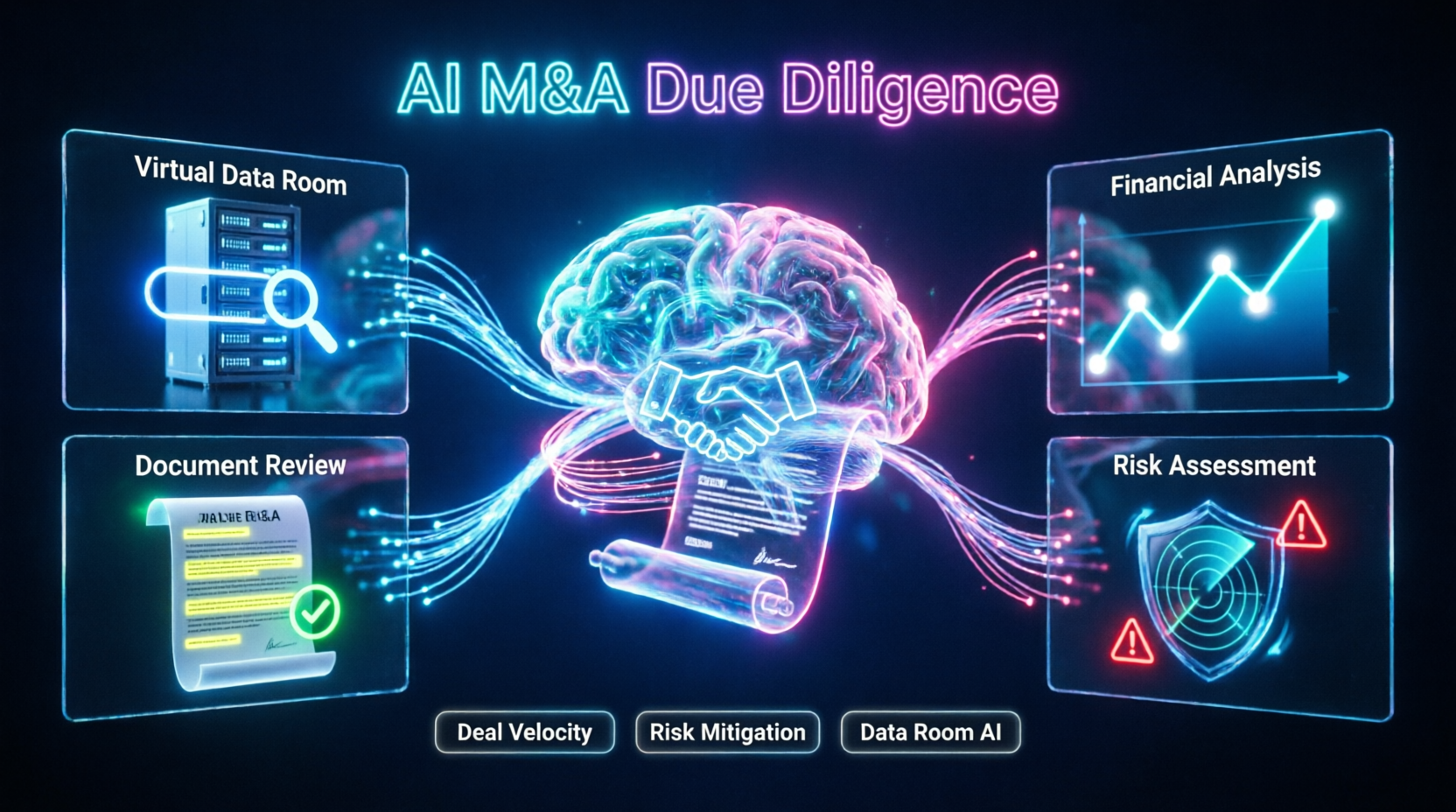
The traditional Virtual Data Room (VDR) has evolved from a passive digital filing cabinet into an active, intelligent workspace. Virtual data room AI analysis is transforming how buyers interact with seller-provided information.
Automated Indexing and Categorization: Upon ingestion, AI algorithms automatically classify thousands of documents into logical categories (e.g., employment agreements, IP assignments, customer contracts, litigation files) without manual tagging. This instantly creates a structured, searchable repository, saving hundreds of hours of administrative setup.
Cross-Document Consistency Checks: One of the most powerful features of virtual data room AI analysis is its ability to cross-reference data across disparate documents. For example, the AI can instantly flag if the revenue figures in a target company’s financial model contradict the terms outlined in their major customer contracts, highlighting discrepancies that human reviewers might easily miss in a sea of data.
4. Risk Mitigation: Generating an AI Red Flag Report M&A
Speed is essential in M&A, but not at the expense of thoroughness. The ability to rapidly generate an AI red flag report M&A is perhaps the most valuable application of this technology for buy-side teams.
Instant Anomaly Detection: Instead of waiting weeks for a manual diligence summary, deal teams can prompt the AI to scan the entire data room for specific, high-risk criteria. The system can instantly generate a comprehensive report highlighting missing assignment-of-IP clauses, unusual termination rights, or pending litigation mentions.
Dynamic Due Diligence Checklist Automation: Static Excel checklists are being replaced by due diligence checklist automation. As the AI reviews documents, it automatically checks off completed items, flags missing requested documents, and updates the diligence status in real time. This provides deal partners and stakeholders with a live, transparent view of the diligence progress, reducing friction and accelerating the path to signing.
5. Financial and Operational Insights: Financial Due Diligence AI Tools
While legal review is critical, the financial health of a target is equally paramount. Financial due diligence AI tools are now capable of ingesting massive datasets, such as general ledgers, bank statements, and ERP exports, to provide deep operational insights.
Revenue Quality and EBITDA Normalization: AI tools can rapidly analyze millions of transaction lines to identify non-recurring revenue, unusual customer concentration, or hidden expenses that should be added back to EBITDA. This automated normalization process provides a much clearer picture of the target’s true recurring cash flow.
Working Capital and Trend Analysis: By analyzing historical financial data, AI can identify seasonal trends, anomalies in accounts receivable aging, or irregularities in inventory valuation, providing the buy-side team with powerful leverage during purchase price allocation and indemnity negotiations.
6. Strategic Implementation: Best Practices for Buy-Side Due Diligence AI
Ultimately, adopting buy-side due diligence AI is not a simple plug-and-play operation; it requires a strategic, phased approach to ensure high adoption rates among deal professionals and measurable ROI.
Data Preparation and Playbook Digitization: AI models are only as good as the rules they are given. Before implementation, organizations must digitize their M&A diligence playbooks and risk tolerances. Clean, well-organized historical data and clear business rules are the fuel that powers accurate AI models.
Change Management and Deal Team Upskilling: The introduction of advanced AI often triggers anxiety among junior analysts who may view it as a threat to their traditional roles. Successful implementation requires robust change management. Frame the technology as an “AI co-pilot” designed to eliminate tedious, low-value document sorting. Invest in upskilling your team to become “AI supervisors” who manage exceptions, validate complex outputs, and focus on high-level deal strategy and negotiation.
Ironclad Security and Data Privacy: When handling highly sensitive, non-public M&A data, security is non-negotiable. Prioritize vendors that offer enterprise-grade security certifications (SOC 2 Type II, ISO 27001) and provide options for private cloud or virtual private cloud (VPC) deployment. Ensure the vendor’s terms explicitly state that your deal data will not be used to train their public models.
7. Comprehensive Query Coverage
What are the primary benefits of AI M&A due diligence? The primary benefits of AI M&A due diligence include a drastic reduction in document review time (often by 40-60%), improved accuracy in identifying hidden risks, automated cross-document consistency checks, and the ability to generate instant AI red flag reports and M&A summaries, accelerating overall deal velocity.
How does virtual data room AI analysis improve the diligence process? Virtual data room AI analysis improves the process by automatically ingesting, classifying, and indexing thousands of documents upon upload. It eliminates manual tagging, enables natural language search across the entire data room, and performs cross-document validation to catch discrepancies between financial and legal records.
What should I look for in financial due diligence AI tools? When evaluating financial due diligence AI tools, look for capabilities in automated EBITDA normalization, revenue quality analysis, working capital trend identification, and seamless integration with major ERP systems and data formats (e.g., CSV, Excel, SQL).
Can due diligence checklist automation replace human judgment? No. Due diligence checklist automation handles the repetitive, administrative tracking of document collection and basic clause extraction. However, human judgment remains essential for interpreting complex strategic implications, negotiating terms, and making the final go/no-go decision on a deal.
How do I ensure data security when using buy-side due diligence AI? To ensure data security, select vendors that offer private deployment options, robust encryption (both in transit and at rest), strict access controls, and contractual guarantees that your sensitive deal data will not be used for model training. Always conduct a thorough third-party security audit before onboarding.
Conclusion
Mastering AI M&A due diligence is no longer just a task for the IT department; it is a strategic imperative for managing partners, general counsel, and corporate development officers alike. By moving beyond manual processes and understanding the nuances of M&A document review AI, financial due diligence AI tools, and due diligence checklist automation, you can ensure your practice operates with unprecedented speed, accuracy, and risk mitigation.
Whether you are searching for deal document analysis software to accelerate your M&A due diligence or aiming to automate your entire compliance monitoring pipeline, the key to success lies in aligning the vendor’s technological capabilities with your specific security requirements and operational workflows.
As artificial intelligence continues to evolve, the cognitive capabilities of these systems will only deepen, making sophisticated deal intelligence accessible and indispensable for firms of all sizes. Embrace the power of intelligent M&A technology today, and position your organization at the absolute forefront of the automated deal-making revolution.