Mastering AI contract redlining is the absolute best way to ensure your legal and business teams navigate complex negotiations with unprecedented speed, accuracy, and risk mitigation. In an era where deal velocity is paramount, and contract volumes are skyrocketing, relying on manual, line-by-line document review and basic word processor track changes is no longer a viable strategy for modern legal operations. Today, forward-thinking law firms, corporate legal departments, and procurement teams are leveraging advanced document comparison AI to automate tedious workflows, instantly spot hidden deviations, and accelerate the path to signature. However, integrating these tools requires strategic foresight. If you are looking to understand exactly how to evaluate these technologies and select the right redline automation software to future-proof your contracting process, you are in the right place.
This comprehensive guide demystifies the technological horizon of modern legal review. We will explore the core capabilities of track changes AI review, detail how contract version control AI eliminates negotiation chaos, and provide a strategic blueprint for utilizing AI markup suggestions for contracts. By the end of this article, you will have a clear, actionable framework for evaluating a side-by-side contract comparison tool, understanding the nuances of negotiation redline AI, and choosing the perfect workflow that delivers maximum ROI and legal certainty.
1. The Evolution of Legal Review: Why AI Contract Redlining Matters in 2026
Historically, the contract negotiation phase was defined by endless email chains, confusingly named files (e.g., “Final_Final_V3_ReallyFinal.docx”), and junior associates spending countless hours manually comparing documents to find a single altered comma or modified liability cap. As the complexity and volume of commercial agreements have grown exponentially, this traditional model has become economically unsustainable and prone to costly human error. The emergence of sophisticated Natural Language Processing (NLP) and machine learning algorithms has introduced a paradigm shift.
Understanding how to leverage AI for contract redlining is critical because the gap between AI-native legal teams and legacy practices is widening rapidly. Organizations that fail to modernize their review workflows risk severe inefficiencies, missed red flags, and delayed deal closures. The shift from basic, character-level diffing to cognitive, context-aware AI contract redlining represents a monumental upgrade in capability. Modern systems do not just highlight added or deleted text; they comprehend legal intent, identify subtle deviations from your company’s preferred playbook, and predict potential liabilities. According to a 2026 Thomson Reuters Report on the State of Legal Tech, firms that successfully integrate advanced AI contract redlining into their core operations report a 50% reduction in review time and a 35% decrease in post-signature disputes.
2. Core Capabilities: How Document Comparison AI Transforms Legal Workflows
To make informed technology investments, you must first understand the primary drivers behind modern document comparison AI. These solutions typically leverage a combination of machine learning, NLP, and optical character recognition (OCR) to transform unstructured legal text into structured, actionable insights.
Semantic Understanding vs. Simple Text Matching: Unlike legacy systems that rely on rigid, character-by-character matching, modern document comparison AI understands the semantic meaning of legal language. It can identify that “Indemnification shall be limited to direct damages” and “The indemnifying party is only liable for direct losses” mean the same thing, even if the wording is entirely different. This prevents false positives and allows reviewers to focus on substantive changes rather than cosmetic rephrasing.
Playbook Alignment and Risk Scoring: Advanced redline automation software goes beyond simple comparison to provide predictive insights. By analyzing the redlined document against your organization’s pre-defined legal playbook, the system can instantly assign a “risk score” to specific clauses, alerting deal teams to non-standard terms, missing protections, or unfavorable jurisdictional stipulations before a definitive agreement is ever signed.
3. Speed and Accuracy: The Power of Redline Automation Software
Speed is essential in contract negotiations, but not at the expense of thoroughness. The ability to rapidly deploy redline automation software is perhaps the most valuable application of this technology for high-volume legal and procurement teams.
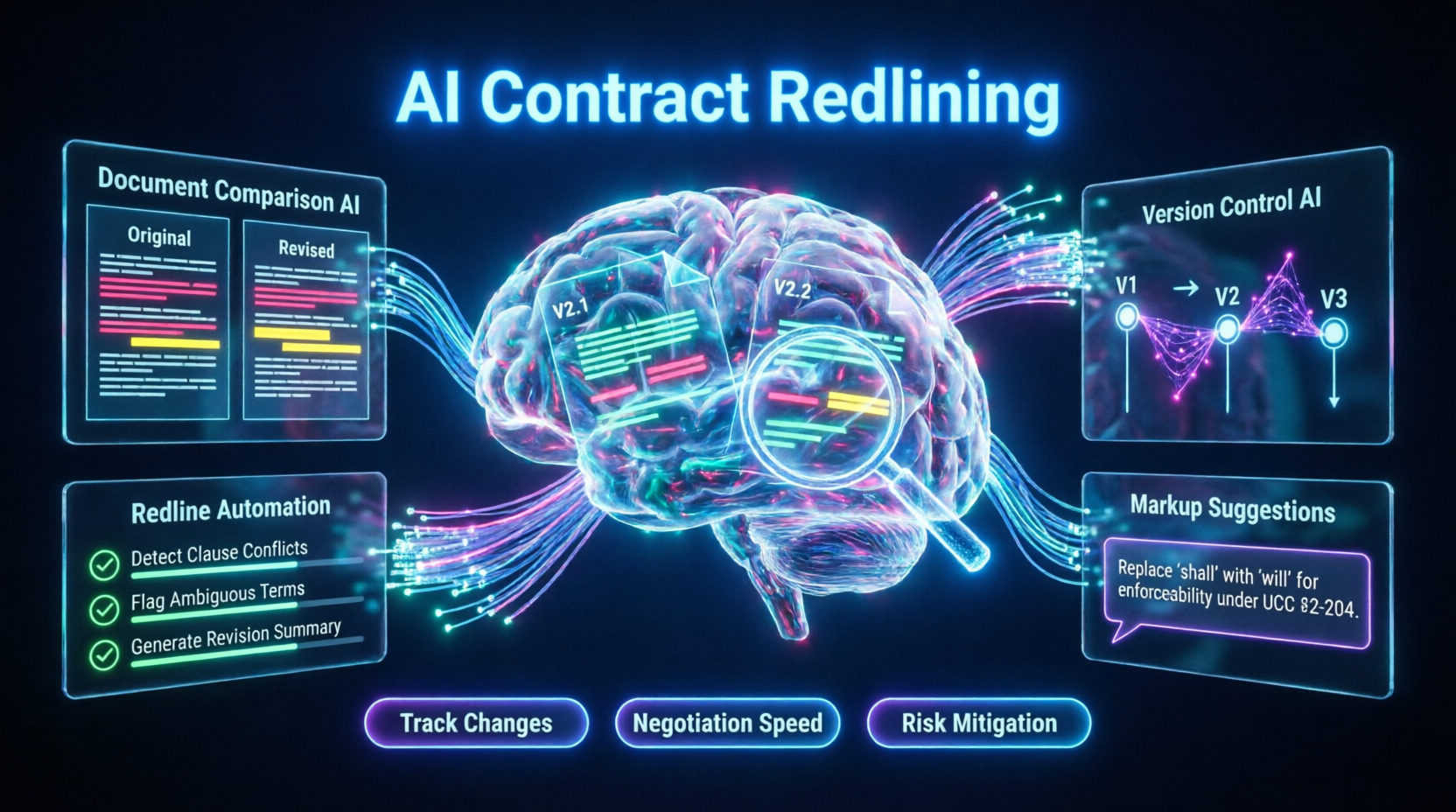
Instant Anomaly Detection: Instead of waiting hours for a manual review of a 50-page vendor agreement, legal teams can prompt the AI to scan the incoming draft against the last agreed-upon version or a standard template. The system can instantly generate a comprehensive report highlighting unusual termination rights, altered payment terms, or unauthorized additions to the scope of work.
Eliminating Human Fatigue: Manual redlining is notoriously susceptible to “reviewer fatigue,” where critical changes are missed simply because the reviewer has been staring at dense legal text for hours. Redline automation software operates with consistent, unwavering accuracy, ensuring that every single insertion, deletion, and formatting change is captured and presented clearly, regardless of the document’s length.
4. Beyond Basic Track Changes: Advanced Track Changes AI Review Features
While Microsoft Word’s “Track Changes” has been the industry standard for decades, it is a blunt instrument. Track changes AI review elevates this concept by adding layers of intelligence and context to every modification.
Explanatory Annotations: Modern track changes AI review tools don’t just show what changed; they explain why it matters. If a counterparty changes a “Net 30” payment term to “Net 60,” the AI can automatically append a comment explaining the cash flow impact and suggesting a predefined fallback position based on company policy.
Visual Clarity in Complex Documents: When dealing with heavily negotiated contracts with hundreds of edits, standard track changes become a chaotic sea of red and blue text. Advanced track changes AI review platforms offer clean, summarized views, grouping related changes together (e.g., “All changes to the Limitation of Liability section”) and allowing reviewers to accept or reject clusters of changes with a single click.
5. Strategic Negotiation: Utilizing AI Markup Suggestions for Contracts
The most sophisticated AI contract redlining platforms are moving from passive review to active negotiation assistance through AI markup suggestions.
Proactive Fallback Generation: When the AI detects a high-risk deviation from your playbook, it doesn’t just flag it; it can automatically generate a redlined alternative. For example, if a vendor inserts an overly broad intellectual property assignment clause, the negotiation redline AI can instantly suggest and apply your company’s standard, balanced IP clause, ready for the attorney to review and send back.
Counterparty Behavior Analysis: Some advanced negotiation redline AI tools analyze historical data to identify patterns in specific counterparty behavior. If the system recognizes that “Vendor X” always attempts to remove the audit rights clause, it can proactively alert the negotiator to hold firm on that specific point, providing a strategic advantage at the bargaining table.
6. Best Practices for Implementing Contract Version Control AI
Ultimately, adopting contract version control AI is not a simple plug-and-play operation; it requires a strategic, phased approach to ensure high adoption rates among legal professionals and measurable ROI.
Digitize and Centralize Your Legal Playbook. AI models are only as good as the rules they are given. Before implementation, organizations must digitize their contracting playbooks, fallback positions, and risk tolerances. Clean, well-organized business rules are the fuel that powers accurate AI markup suggestions for contracts.
Seamless Integration with Existing Tech Stack: To drive adoption, the side-by-side contract comparison tool must integrate seamlessly with the software your team already uses. Look for solutions that offer robust plugins for Microsoft Word, seamless API connections to your Contract Lifecycle Management (CLM) system, and secure cloud storage integrations (e.g., SharePoint, iManage).
Ironclad Security and Data Privacy: When handling highly sensitive, confidential agreements, security is non-negotiable. Prioritize vendors that offer enterprise-grade security certifications (SOC 2 Type II, ISO 27001) and provide options for private cloud or virtual private cloud (VPC) deployment. Ensure the vendor’s terms explicitly state that your contract data will not be used to train their public models.
7. Comprehensive Query Coverage
What are the primary benefits of AI contract redlining? The primary benefits of AI contract redlining include a drastic reduction in document review time (often by 40-60%), improved accuracy in identifying hidden risks, automated alignment with company playbooks, and the ability to generate instant, intelligent redlines, accelerating overall deal velocity.
How does document comparison AI differ from standard Word track changes? Standard track changes only highlight character-level additions and deletions. Document comparison AI understands the semantic meaning of the text, groups related changes logically, explains the legal impact of the modification, and can even suggest compliant fallback language, acting as an intelligent legal co-pilot.
What should I look for in a side-by-side contract comparison tool? When evaluating a side-by-side contract comparison tool, look for features like semantic (not just literal) comparison, the ability to compare different file formats (e.g., Word to PDF), visual clarity tools that reduce clutter, and seamless integration with your existing Contract Lifecycle Management (CLM) software.
Can redline automation software replace human lawyers? No. Redline automation software handles the repetitive, administrative tasks of identifying and categorizing changes. However, human judgment remains essential for interpreting complex strategic implications, negotiating business terms, and making the final decision on risk acceptance. The AI augments the lawyer; it does not replace them.
How do I ensure data security when using negotiation redline AI? To ensure data security, select vendors that offer private deployment options, robust encryption (both in transit and at rest), strict role-based access controls, and contractual guarantees that your sensitive contract data will not be used for third-party model training. Always conduct a thorough third-party security audit before onboarding.
Conclusion
Mastering AI contract redlining is no longer just a task for the IT department; it is a strategic imperative for managing partners, general counsel, and legal operations professionals alike. By moving beyond manual processes and understanding the nuances of document comparison AI, track changes AI review, and contract version control AI, you can ensure your practice operates with unprecedented speed, accuracy, and risk mitigation.
Whether you are searching for a side-by-side contract comparison tool to accelerate your M&A due diligence or aiming to automate your entire vendor negotiation pipeline with redline automation software, the key to success lies in aligning the vendor’s technological capabilities with your specific security requirements and operational workflows.
As artificial intelligence continues to evolve, the cognitive capabilities of these systems will only deepen, making sophisticated contract intelligence accessible and indispensable for legal teams of all sizes. Embrace the power of intelligent legal technology today, and position your organization at the absolute forefront of the automated negotiation revolution.