Implementing an advanced adaptive AI document tool is the absolute best way to transform your document processing workflows from static, rule-based bottlenecks into dynamic, self-optimizing engines of productivity. In an era where businesses are inundated with complex, unstructured data, relying on traditional Optical Character Recognition (OCR) and rigid automation scripts is no longer a viable strategy for operational efficiency. Today, forward-thinking enterprises are leveraging intelligent systems that improve with every interaction. If you are looking to understand exactly how modern artificial intelligence refines its accuracy and tailors its outputs to your specific business context, you are in the right place.
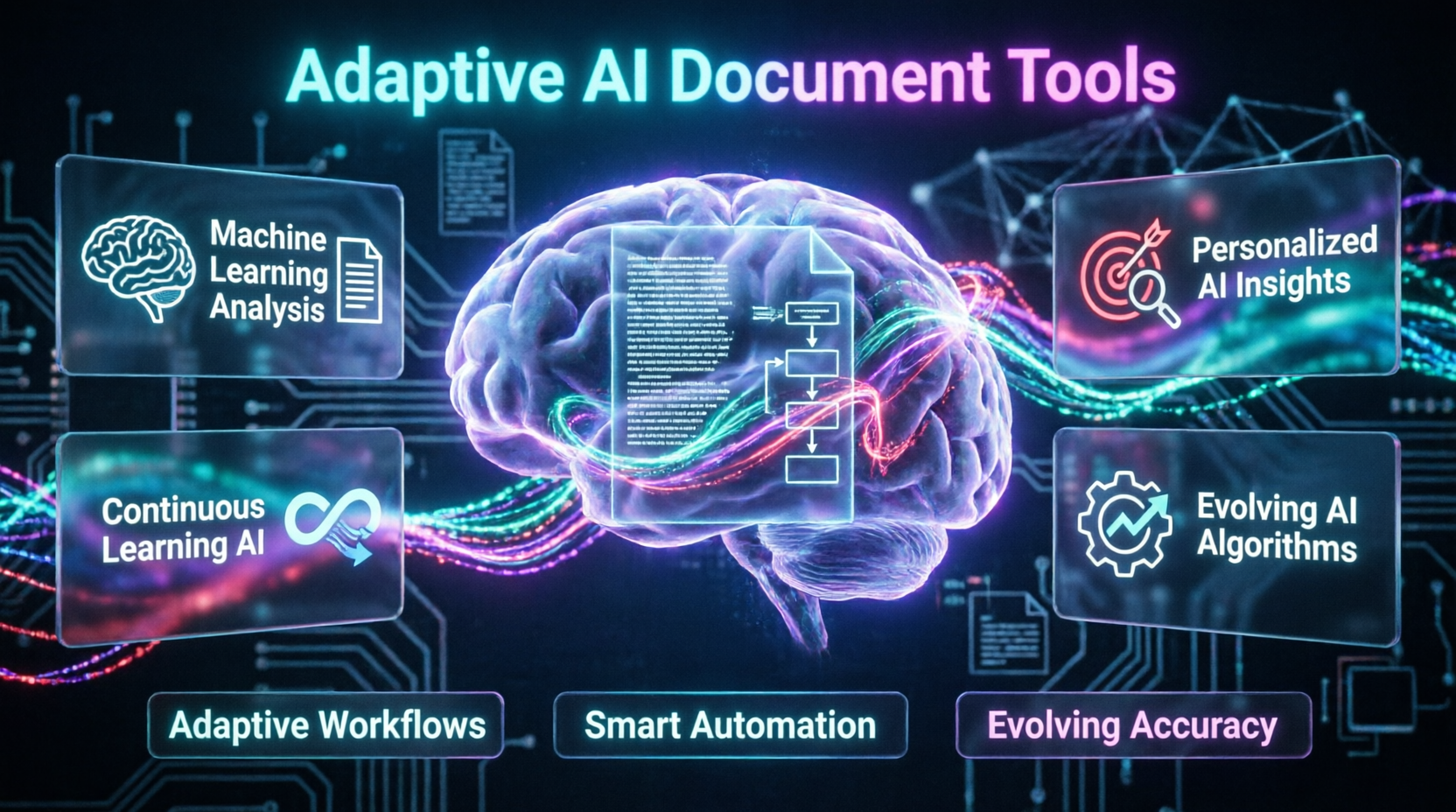
This comprehensive guide demystifies the mechanics of continuous machine learning in document processing. We will explore the foundational technology behind machine learning document analysis, detail the feedback loops that power AI that learns from data, and provide a strategic blueprint for deploying a continuous learning AI platform. By the end of this article, you will have a clear, actionable framework for generating personalized AI insights, understanding evolving AI algorithms, and selecting the perfect adaptive AI document tool to future-proof your organization’s data workflows.
1. The Evolution of Document Processing: Why an Adaptive AI Document Tool Matters in 2026
Historically, document automation relied on template-based OCR and rigid, if-then rule engines. These legacy systems required manual configuration for every new document format. If a vendor changed the layout of an invoice by a few pixels, the entire extraction process would fail, requiring IT intervention to rewrite the rules. This static approach was highly fragile and unscalable.
The emergence of the adaptive AI document tool represents a quantum leap in Intelligent Document Processing (IDP). Unlike legacy systems, modern AI utilizes deep learning and natural language processing (NLP) to understand the semantic meaning and structural context of a document, regardless of its layout. More importantly, it possesses the ability to learn from its mistakes and adapt to new document variations autonomously. According to recent research by Gartner on Continuous Machine Learning (CML), organizations that deploy adaptive AI systems reduce manual document review times by up to 70% over a 12-month period, as the system’s accuracy compounds with every processed file.
2. The Engine of Improvement: Machine Learning Document Analysis Explained
To understand how an adaptive AI document tool gets smarter, you must first understand the mechanics of machine learning document analysis. At its core, this technology moves beyond simple character recognition to contextual comprehension.
Feature Extraction and Pattern Recognition: When an AI processes a document, it doesn’t just read text; it extracts “features.” These include the spatial relationship between words, the font styles, the presence of specific keywords, and the overall document structure. By analyzing thousands of documents, the machine learning model identifies patterns. For example, it learns that a 9-digit number located near the word “Tax ID” is almost certainly a tax identification number, even if the document layout changes.
Semantic Understanding via NLP: Advanced machine learning document analysis leverages Large Language Models (LLMs) and transformer architectures to understand context. If a document mentions “Apple,” the AI uses surrounding context to determine if it refers to the tech company or the fruit. This semantic understanding allows the AI to accurately extract data from highly unstructured documents like emails, contracts, and medical records, where rigid templates would completely fail.
3. The Feedback Loop: How AI That Learns from Data Operates
The true magic of an adaptive AI document tool lies in its feedback loop. This is the mechanism that transforms a standard AI model into AI that learns from data continuously.
Human-in-the-Loop (HITL) Validation: In the early stages of deployment, the AI will inevitably encounter edge cases or unfamiliar document formats, resulting in low-confidence predictions. These documents are routed to a human reviewer via a centralized dashboard. When the human corrects the AI’s extraction error (e.g., changing the extracted date from MM/DD/YYYY to DD/MM/YYYY), this correction is not just saved; it is fed back into the model’s training pipeline.
Active Learning and Model Retraining: The system uses a technique called active learning to prioritize which human corrections will yield the greatest improvement. Instead of retraining on all data, the AI that learns from data specifically targets the edge cases and low-confidence predictions. Over weeks and months, as the human reviewers correct fewer and fewer errors, the model’s baseline accuracy climbs, eventually reaching a state of “straight-through processing” (STP) where human intervention is rarely needed.
4. Scaling Intelligence: The Power of a Continuous Learning AI Platform
As your business grows, the volume and variety of your documents will change. A static model will degrade in performance, a phenomenon known as “data drift.” This is why deploying a continuous learning AI platform is critical for long-term success.
Automated Drift Detection: A robust continuous learning AI platform constantly monitors the statistical properties of incoming documents. If it detects that a new vendor is sending invoices in a completely different format, or if the terminology in your industry shifts, the system flags this “drift.” It automatically triggers a retraining cycle using the newly accumulated, human-verified data, ensuring the model remains highly accurate without manual IT oversight.
Version Control and Model Governance: Continuous learning requires strict governance. Enterprise-grade platforms maintain rigorous version control for every iteration of the AI model. If a newly trained model performs worse on a specific document type, the system can automatically roll back to the previous, more stable version. This ensures that your document processing workflows remain reliable and compliant, even as the underlying AI that learns from data constantly evolves.
5. Tailored Results: Generating Personalized AI Insights
An adaptive AI document tool does more than just extract data; it contextualizes it to generate personalized AI insights specific to your organization’s unique needs.
Custom Entity Extraction: Every business has proprietary data points that generic AI models don’t recognize. Through continuous learning, you can train the system to identify custom entities. For example, a logistics company can teach its AI to recognize and extract specific internal routing codes, while a legal firm can train it to identify highly specific jurisdictional clauses. The AI adapts to your vocabulary, not the other way around.
Predictive Analytics and Workflow Automation: Once the AI has accurately extracted and structured your document data, it can begin to analyze trends. A continuous learning AI platform can identify that invoices from a specific vendor consistently contain late fees, or that contracts with a certain clause take 30% longer to approve. These personalized AI insights allow you to move from reactive document processing to proactive business intelligence, optimizing your operations based on the actual data hidden within your files.
6. Future-Proofing Your Workflow with Evolving AI Algorithms
The field of artificial intelligence is advancing at a breakneck pace. To ensure your investment remains relevant, you must choose an adaptive AI document tool built on evolving AI algorithms.
Integration of Generative AI and LLMs. Modern document processing is increasingly integrating generative AI. Instead of just extracting a clause from a 50-page contract, evolving AI algorithms can now summarize the entire document, highlight risks, and draft a response in plain English. As foundational LLMs improve, your document tool inherits these capabilities, constantly expanding its functional scope.
Multi-Modal Processing: The next frontier of machine learning document analysis is multi-modal AI. Future algorithms will seamlessly process text, tables, handwritten notes, and even embedded images or charts within a single document, understanding the relationships between all these elements. By choosing a platform committed to evolving AI algorithms, you ensure your infrastructure is ready to handle the complex, multi-modal documents of tomorrow.
7. Comprehensive Query Coverage
What exactly is an adaptive AI document tool? An adaptive AI document tool is an Intelligent Document Processing (IDP) system that uses machine learning to not only extract data from documents but also continuously improve its accuracy over time. It learns from human corrections and adapts to new document formats without requiring manual reprogramming.
How does machine learning document analysis differ from traditional OCR? Traditional OCR simply converts images of text into machine-readable text based on rigid templates. Machine learning document analysis uses deep learning to understand the context, layout, and semantic meaning of the document, allowing it to accurately process unstructured and highly variable documents that would break traditional OCR systems.
How does AI that learns from data protect sensitive information during training? Enterprise-grade AI that learns from data employs strict data governance. It uses techniques like data anonymization, encryption at rest and in transit, and isolated training environments. Furthermore, reputable vendors guarantee that your proprietary document data is never used to train their public, foundational models.
What is the role of a continuous learning AI platform in preventing data drift? A continuous learning AI platform constantly monitors incoming data for statistical anomalies (data drift). When it detects that document formats or terminologies have changed, it automatically flags the shift and initiates a targeted retraining cycle using recent, human-verified data, ensuring the model’s accuracy never degrades over time.
Can personalized AI insights be customized for specific industries? Absolutely. Personalized AI insights are highly customizable. Whether you are in healthcare needing to extract specific ICD-10 codes or in finance tracking complex amortization schedules, an adaptive AI tool can be trained on industry-specific datasets to deliver highly relevant, contextual insights that generic tools cannot provide.
Conclusion
Mastering the capabilities of an adaptive AI document tool is the most empowering step you can take to future-proof your organization’s data workflows. By moving beyond static, rule-based automation and embracing machine learning document analysis, you unlock a system that grows more accurate, efficient, and valuable with every single document it processes.
Whether you are implementing a continuous learning AI platform to combat data drift, leveraging AI that learns from data to achieve straight-through processing, or utilizing personalized AI insights to drive strategic decisions, the key to success lies in choosing a platform built on evolving AI algorithms.
As artificial intelligence continues to advance, the gap between organizations that use static tools and those that deploy adaptive, learning systems will only widen. Embrace the power of continuous machine learning today, and position your document workflows at the absolute forefront of the intelligent automation revolution.